
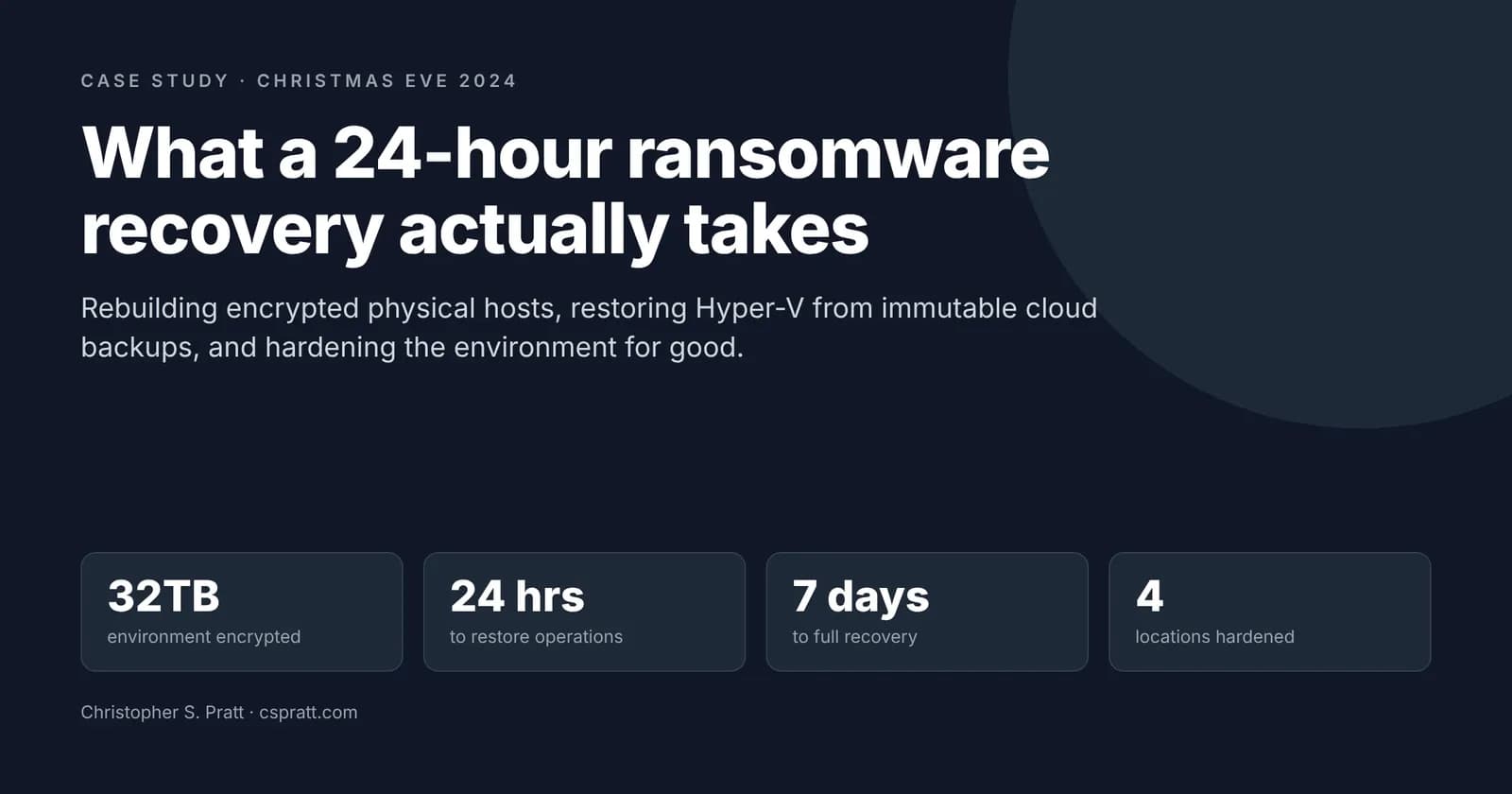
When a client's 32TB environment was hit by ransomware on Christmas Eve 2024, the headline numbers were operations restored in 24 hours and full recovery in 7 days. Those numbers weren't won during the incident. They were won in the planning that came before it.
This attack didn't stop at a few file shares. It encrypted the operating systems on the physical host servers themselves, the machines that run every virtual server in the environment. Before anything else could come back, the foundation had to be rebuilt. And it had to happen over the holiday: attackers often strike when fewer people are watching, and this one picked the night before Christmas. Thanks to the 24-hour recovery, the business was operating again by Christmas Day.
This post covers what made that timeline possible, how the rebuild ran step by step, how we hardened the environment so the same attack can't work twice, and how we kept the work aligned with ITIL practice and the client's SOC 1 and SOC 2 obligations the whole way through.
The four foundations that decided the outcome

1. Backups that can't be encrypted
Immutable local and cloud backups mean an attacker with administrative access still cannot rewrite or delete the recovery points. Without that, everything else is guesswork. In this incident, the immutable cloud copies were the source for every virtual machine we restored.
2. Standby images
Restoring terabytes takes time. Having standby images means the most important systems can be brought back first, while the long tail of data restores continues in the background. That is the gap between 24 hours and 7 days: the business was running again on day one while the bulk of the 32TB finished restoring.
3. Rehearsal
Tabletop exercises and real recovery tests turn a plan from a document into muscle memory. During an incident nobody should be reading the runbook for the first time.
4. A clear incident lead
Someone has to direct the engineers, talk to leadership and decide what comes back first. Clear roles keep a small team moving in one direction.
What we were facing
The ransomware had encrypted the operating systems on the client's physical host servers. With the hosts down, every virtual machine they ran went down too: the domain controllers, the on-premises file servers and the application servers.

Two decisions came first:
- Rebuild, don't repair. Every encrypted host was treated as untrustworthy. Nothing the attacker had touched went back into production. Each physical host OS was wiped and reinstalled from known-good media.
- Contain before restoring. Affected systems stayed isolated until clean rebuilds were ready, so restored machines couldn't be reinfected on the way back up.
Finding the way in
Rebuilding is pointless if the attacker still has a way back in. So alongside the rebuild, we ran threat hunting and root-cause analysis to find how the attack got in.
- Threat hunting. We searched SentinelOne telemetry, firewall logs and sign-in records across the environment for the attacker's footprints: unusual logins, new or changed accounts, remote-access tools and movement between machines.
- Root-cause analysis. Following that trail backward led to a single workstation: the entry point for the attack.
- Isolation. That workstation was cut off from the network straight away and kept out of production, so it could be examined without giving the attacker a path back in.

Knowing the entry point also shaped the hardening that came next. The firewall and access changes below were aimed at the path the attacker actually used, not just general best practice.
The rebuild, in order
- Remote access through iDRAC. The servers' iDRAC out-of-band management gave us full console access to each physical host without waiting for someone on site. We could mount install media, watch each server boot and work on several hosts at once.
- Reinstall every host OS. Each physical host was wiped and rebuilt with a clean operating system, patched before it rejoined the network.
- Bring the hypervisors back. On the clean hosts we reinstalled and configured Microsoft Hyper-V, rebuilt the virtual networking and storage connections, and confirmed each host was healthy before giving it any workloads.
- Restore virtual machines from immutable cloud backups. Domain controllers came first, because everything else authenticates against them. The on-premises file servers and application servers followed, in the priority order agreed with the business.
- Validate, then reopen. Each restored system was scanned and checked before users were allowed back on.

That sequence restored operations in 24 hours. The remaining data restores ran in the background, and the environment was fully recovered in 7 days.

Closing the door behind us
Restoring service is only half the job. The other half is making sure the same attack can't work again.
Firewall hardening at all four locations
The client ran SonicWall firewalls at each of its 4 locations. We reviewed and hardened every security policy at all four:
- removed stale and overly broad allow rules
- limited remote access and firewall management to approved sources
- turned on the security services that inspect traffic, not just route it
- standardized the rule set so all four sites follow one baseline
MDR on top of EDR
SentinelOne EDR was already installed on every workstation and server. We deployed managed detection and response (MDR) to complement it. EDR is the tool on each device that detects and blocks threats. MDR adds a team of analysts who watch those alerts around the clock, investigate them and respond, including nights, weekends and holidays like the one this attack chose.

How the response maps to ITIL (Version 5)
ITIL (Version 5), released by PeopleCert in early 2026, builds on ITIL 4 and keeps its 34 management practices and guiding principles. The recovery happened in December 2024, but the practices it relied on carry straight through. Here is how the work lines up:

- Incident management: one incident lead and one priority order, focused on restoring service as fast as possible.
- Information security management: containment, clean rebuilds, firewall hardening and layered detection.
- Change enablement: every rebuild and firewall change recorded and approved, including emergency changes.
- Service configuration management: known-good builds for hosts and Hyper-V, documented as they were rebuilt.
- Monitoring and event management: MDR analysts watching SentinelOne alerts around the clock.
- Problem management: threat hunting and root-cause analysis traced the entry-point workstation, so the same path can't be used again.
- Supplier management: backup, security and MDR providers coordinated under one plan.
- Relationship management: regular, plain-language updates to leadership throughout.
- Continual improvement: lessons learned turned into updated runbooks and recovery tests.
The guiding principles showed up too. Focusing on value meant restoring what the business needed first. Starting where you are meant using the immutable backups and standby images already in place, instead of inventing a plan mid-incident.
Keeping SOC 1 and SOC 2 Type I and Type II intact
The client's controls had to stand up to SOC 1 and SOC 2 examinations, so the recovery could not cut corners on evidence. A quick refresher:
- SOC 1 covers controls that affect clients' financial reporting.
- SOC 2 covers security and the other Trust Services Criteria.
- Type I checks that controls are suitably designed and in place at a point in time.
- Type II tests whether those controls actually operated over a period, typically six to twelve months.
That last point matters most. A Type II period doesn't pause for a ransomware attack. Auditors will look at how the incident was handled, so the response itself became evidence:
- the incident timeline and key decisions logged as they happened
- every change ticketed and approved, emergency changes included
- privileged accounts reviewed and credentials reset, with access rebuilt on least privilege
- backup restores documented, showing the recovery points were intact
- firewall and endpoint configurations captured as new baselines after hardening
- a post-incident review completed, with each action tracked to closure

The environment came out of the incident with its controls in line with SOC 1 and SOC 2 Type I and Type II requirements, and the evidence to show it.
What to do before your own incident
- Make backups immutable, both local and cloud, and test restores on a schedule.
- Keep out-of-band management working. iDRAC or its equivalent should be patched, documented and on an isolated management network.
- Write down the restore order. Identity first, then data, then applications.
- Rehearse. Run tabletop exercises and real recovery tests before you need them.
- Name the incident lead, and a backup for that person.
- Layer detection. EDR on every device, plus people watching it around the clock.
- Keep the audit trail running during the incident, not after it.

The 24 hours were earned in the months before the attack. If you'd like to talk through your own recovery plan, get in touch.
Comments
Leave a comment